FXMaster Banner
What Is Business Foreign Exchange

What Is Business Foreign Exchange?

Business foreign exchange (FX) refers to the process companies use to convert one currency into another when conducting international commercial transactions.

Whenever a company:

  • Pays overseas suppliers
  • Receives international customer payments
  • Sends global payroll
  • Transfers funds between international entities

Foreign exchange is not just a financial task - it directly affects profitability, pricing strategy and financial stability.

Business Foreign Exchange

Even small fluctuations in exchange rates can significantly impact operating margins, especially for businesses transacting frequently across borders.

Understanding How Exchange Rates Work

Exchange rates constantly change based on global
economic conditions.

Rates are influenced by:

  • Inflation levels
  • Interest rates
  • Political stability
  • Trade balances
  • Market demand
Exchange Rates

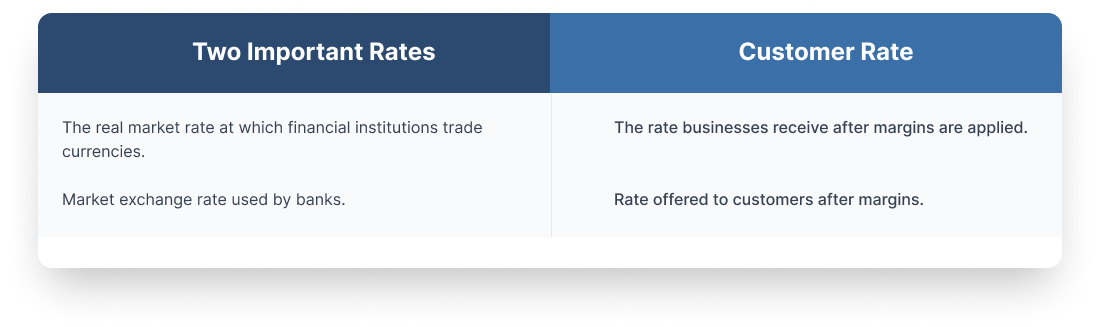
Two Important Rates

Important Rates

Types of Business Currency Transactions

Spot Conversions
Scheduled Conversions
Bulk Currency Conversions
Incoming Currency Conversion
Multi-Currency Holding
Currency Risk & Business Impact

Currency Exchange Rate Volatility

Strategies for Managing Currency Exposure

Business Currency Exchange
1
Conversion Timing Control
Avoid automatic instant conversion for all transactions.
2
Currency Matching
Pay suppliers using revenue received in the same currency.
3
Scheduled Conversion Planning
Convert at consistent intervals to reduce volatility impact.
4
Diversified Currency Holding
Maintain balances in frequently used currencies.
5
Rate Monitoring
Track trends before large transfers.
Global Currency Operations

Operational Benefits of Structured FX Management

Businesses that implement organised currency processes gain measurable operational, forecasting, and financial advantages across global markets.

Cost Reduction
Lower effective conversion expenses and reduce avoidable currency losses.
Financial Forecast Accuracy
Improve budgeting precision and maintain stable forecasting models.
Cash Flow Stability
Reduce exposure to sudden exchange-rate fluctuations.
Accounting Simplicity
Maintain cleaner reconciliation and reporting processes.
Commercial Confidence
Quote international clients more accurately and confidently.
Import & Exports
Ensure predictable settlement and stronger margin control.
Digital Service Companies
Handle recurring global client billing more efficiently.
Recruitment Agencies
Pay international contractors with predictable weekly operations.
E-commerce Businesses
Manage multi-currency revenue streams across international markets.

Traditional Conversion Vs Structured FX Approach

Traditional Conversion Vs Structured FX Approach

Unmanaged vs structured foreign exchange management comparison
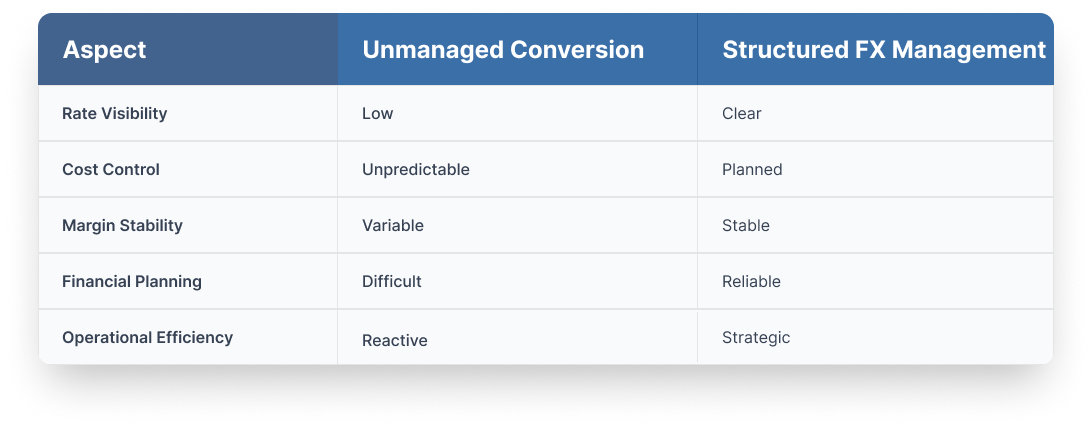
Unmanaged vs structured foreign exchange management comparison
Technology in Currency Management

Technology in Currency Management

Modern financial systems allow businesses to:

  • Monitor exchange rates
  • Schedule conversions
  • Automate recurring exchanges
  • Track historical conversion data
  • Integrate with accounting systems

Building a Currency Management Policy

  • Approved conversion frequency
  • Risk tolerance thresholds
  • Authorisation procedures
  • Monitoring responsibilities
  • Reporting standards

Future of Business Foreign Exchange

  • Predictable conversion costs
  • Transparent rate visibility
  • Automated currency workflows
  • Data-driven financial planning
Currency Risk Management

Why Structured Foreign Exchange Management Matters for Businesses

By implementing structured currency management practices, organisations can:

  • Reduce avoidable conversion losses
  • Improve pricing stability
  • Strengthen financial forecasting
  • Maintain predictable global operations

Business foreign exchange is one of the most significant hidden cost factors in global operations. Companies that ignore currency strategy often experience inconsistent margins and financial uncertainty.

Effective currency management turns international trade from risk exposure into controlled financial activity.

Our FX strategies are designed to support businesses using professional international business payment solutions in the UK .

Frequently Asked Questions

Frequently Asked Questions

Find answers to common questions about our international payment services

Foreign exchange fees are fixed or transaction-based charges applied by a provider, while exchange rate margins are the percentage added to the interbank rate. In many cases, the margin has a larger impact on total conversion cost than the visible transfer fee.
Currency volatility can directly impact business profitability by changing the value of international payments, supplier costs, and overseas revenue. Sudden exchange rate movements may reduce profit margins and create uncertainty in financial forecasting.
Not always. Businesses should evaluate market conditions, cash flow requirements, and future currency exposure before converting funds. Holding foreign currency temporarily may help secure better exchange rates in certain market situations.
Currency exposure refers to the financial risk businesses face when exchange rates fluctuate between the time a deal is agreed and payment is completed. It can affect import costs, export revenue, and overall business stability.
A structured currency management policy helps businesses control exchange rate risk, improve budgeting accuracy, and create consistency in international payment decisions. It also supports better long-term financial planning and operational stability.
Scroll to Top