Business Foreign Exchange & Currency Management – Complete Guide for Global Companies
What Is Business Foreign Exchange?
Business foreign exchange (FX) refers to the process companies use to convert one currency into another when conducting international commercial transactions.
Whenever a company:
- Pays overseas suppliers
- Receives international customer payments
- Sends global payroll
- Transfers funds between international entities
currency conversion becomes necessary.
Foreign exchange is not just a financial task — it directly affects profitability, pricing strategy and financial stability.
Even small fluctuations in exchange rates can significantly impact operating margins, especially for businesses transacting frequently across borders.
Why Currency Management Matters in International Operations
Many companies focus on transfer fees but overlook exchange rate impact.
In reality, FX margins often cost more than payment charges.
Example
- Annual overseas payments: 800,000
- Exchange margin difference: 2%
- Total annual cost impact: 16,000
Without structured currency management, businesses unknowingly lose revenue through avoidable conversion inefficiencies.
Proper foreign exchange management helps businesses:
- Stabilise profit margins
- Forecast costs accurately
- Protect pricing models
- Improve financial planning
Understanding How Exchange Rates Work
Exchange rates constantly change based on global economic conditions.
Rates are influenced by:
- Inflation levels
- Interest rates
- Political stability
- Trade balances
- Market demand
Because of this volatility, the timing of conversion can affect transaction cost significantly.
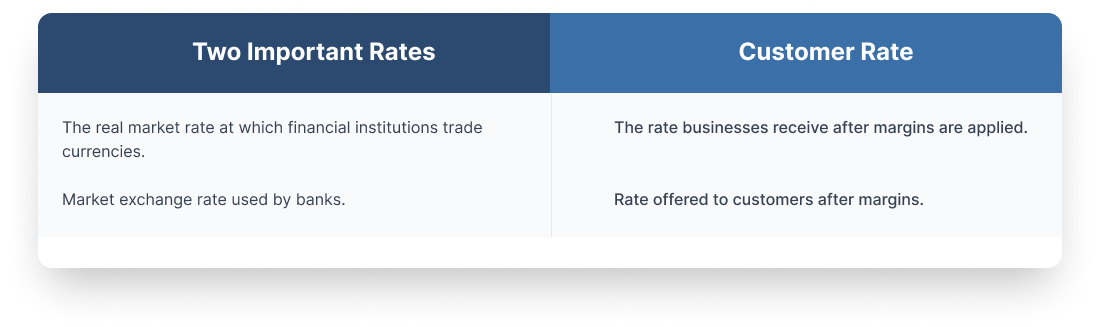
Two Important Rates
Interbank Rate
The real market rate at which financial institutions trade currencies.
Customer Rate
The rate businesses receive after margins are applied.
The difference between these two determines the hidden cost of conversion.
Types of Business Currency Transactions
Spot Conversions
Immediate currency exchange using current market rate.
Best for urgent payments.
Scheduled Conversions
Planned recurring conversions for predictable payments such as payroll.
Bulk Currency Conversions
Converting large volumes before distributing multiple payments.
Incoming Currency Conversion
Receiving foreign currency revenue and converting strategically.
Multi-Currency Holding
Holding funds in original currency until conversion is favourable.
Each method supports different financial strategies depending on business cash flow.
Currency Risk and Its Business Impact
Currency risk occurs when exchange rate movements affect transaction value between agreement and payment date.
Example
- Invoice issued: 10,000 USD
- Exchange rate changes before payment
- Actual received amount differs
This affects:
- Profit margins
- Contract pricing
- Financial reporting
Companies trading internationally should always monitor currency exposure.
Strategies for Managing Currency Exposure

1. Conversion Timing Control
Avoid automatic instant conversion for all transactions.
2. Currency Matching
Pay suppliers using revenue received in same currency.
3. Scheduled Conversion Planning
Convert at consistent intervals to reduce volatility impact.
4. Diversified Currency Holding
Maintain balances in frequently used currencies.
5. Rate Monitoring
Track trends before large transfers.
These strategies reduce unpredictability in international financial operations.
Alt Tag : Structured foreign exchange management process workflow
Operational Benefits of Structured FX Management
Businesses that implement organised currency processes gain measurable advantages.
Cost Reduction
Lower effective conversion expenses.
Financial Forecast Accuracy
Predictable budgeting and pricing models.
Cash Flow Stability
Reduced exposure to sudden market movements.
Accounting Simplicity
Cleaner reconciliation records.
Commercial Confidence
Ability to quote international customers more accurately.
Foreign exchange becomes a controllable cost rather than a variable risk.
Industries Highly Affected by FX Volatility
Importers
Purchase goods in foreign currency regularly.
Exporters
Receive overseas payments exposed to rate changes.
Digital Service Companies
Bill global clients monthly.
Recruitment Agencies
Pay international contractors weekly.
E-commerce Businesses
Manage multi-currency revenue streams.
The more frequent the cross-border activity, the greater the importance of currency management.
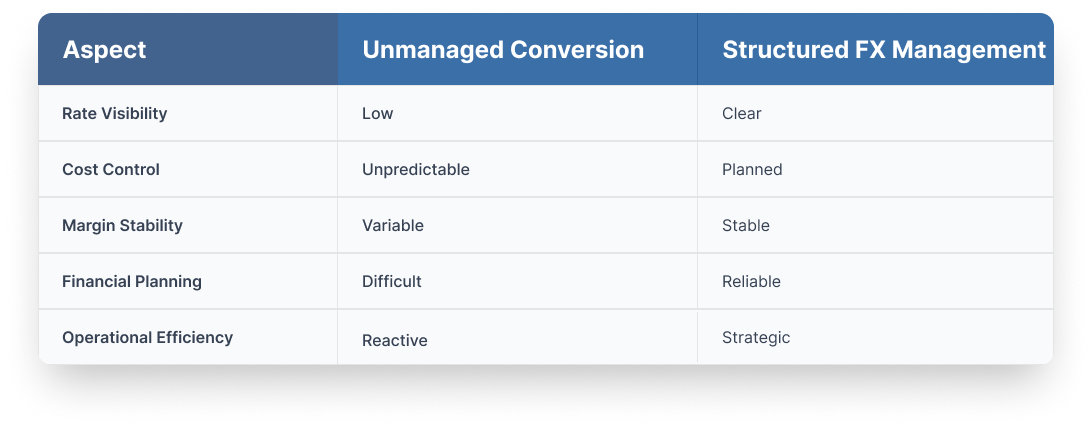
Traditional Conversion vs Structured FX Approach
| Aspect | Unmanaged Conversion | Structured FX Management |
|---|---|---|
| Rate Visibility | Low | Clear |
| Cost Control | Unpredictable | Planned |
| Margin Stability | Variable | Stable |
| Financial Planning | Difficult | Reliable |
| Operational Efficiency | Reactive | Strategic |
Managing currency proactively transforms international operations.
Technology in Currency Management
Modern financial systems allow businesses to:
- Monitor exchange rates
- Schedule conversions
- Automate recurring exchanges
- Track historical conversion data
- Integrate with accounting systems
Technology removes guesswork and improves decision-making.
Building a Currency Management Policy
Companies handling international transactions benefit from internal FX guidelines.
A basic policy includes:
- Approved conversion frequency
- Risk tolerance thresholds
- Authorisation procedures
- Monitoring responsibilities
- Reporting standards
Structured governance ensures consistency and accountability.
Future of Business Foreign Exchange
As global trade expands, currency management becomes a strategic financial discipline rather than an operational afterthought.
Businesses increasingly prioritise:
- Predictable conversion costs
- Transparent rate visibility
- Automated currency workflows
- Data-driven financial planning
Those who manage FX proactively maintain competitive advantage in international markets.
Our FX strategies are designed to support businesses using professional international business payment solutions in the UK .
Conclusion
Business foreign exchange is one of the most significant hidden cost factors in global operations. Companies that ignore currency strategy often experience inconsistent margins and financial uncertainty. Managing foreign exchange effectively helps businesses reduce currency risks, improve cash flow, and make international payments more efficiently. A reliable FX partner can make global transactions simpler, faster, and more cost-effective. Choose FX Master for secure business payments, competitive exchange rates, and hassle-free international currency management.
By implementing structured currency management practices, organisations can:
- Reduce avoidable conversion losses
- Improve pricing stability
- Strengthen financial forecasting
- Maintain predictable global operations
Effective currency management turns international trade from risk exposure into controlled financial activity.